
Fable Is Back. Brilliant, and Expensive.
Fable is the best model I have, and the heaviest. It drains my usage faster and costs more past the limit. On the price of reaching for the strong tool.


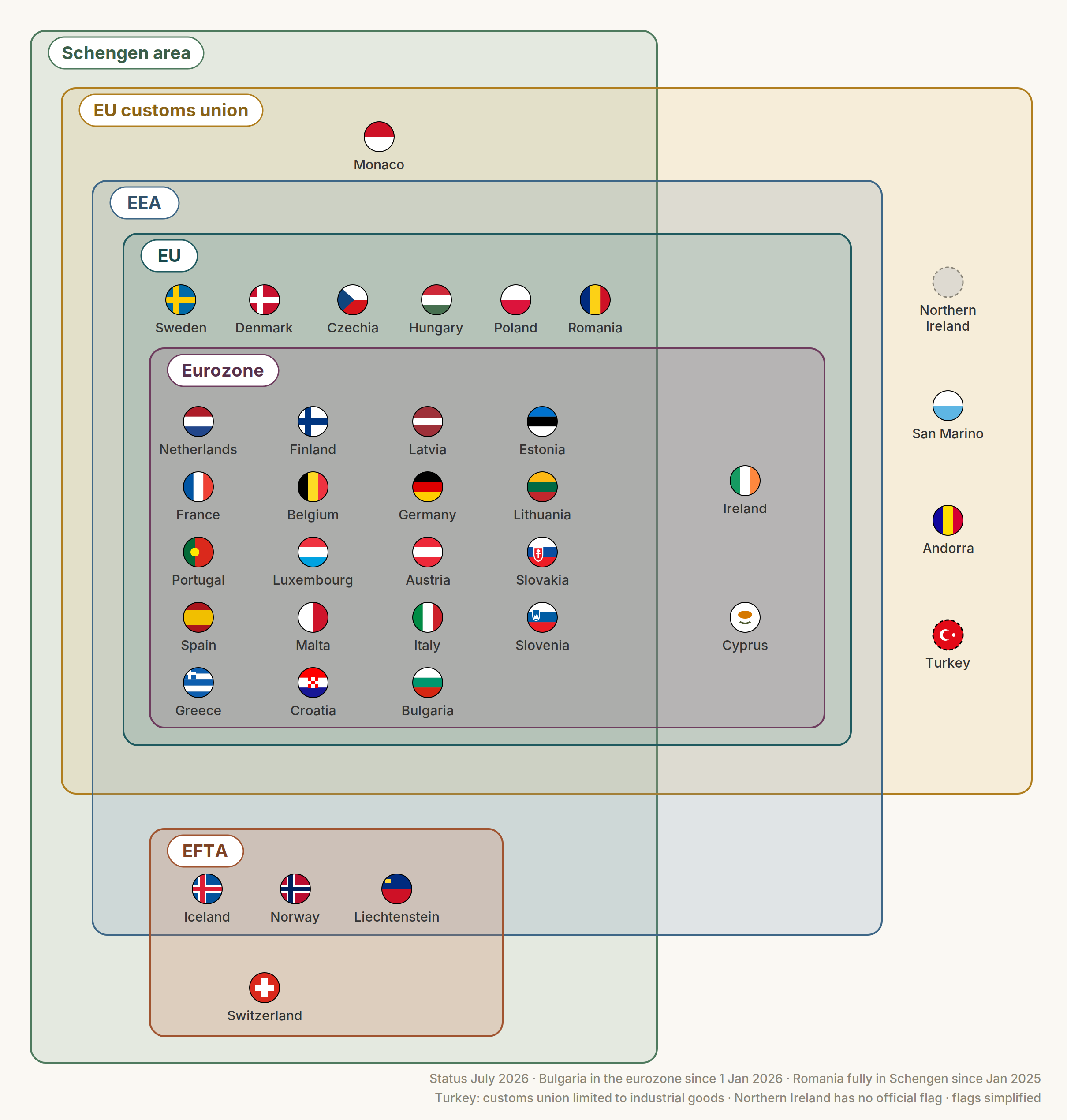
Six categories on one map of Europe. EU, EEA, EFTA, Schengen, the eurozone, the customs union. They nest, they overlap, and they refuse to line up. EFTA sits partly inside the EEA and partly outside it. Switzerland belongs to some and not others. The diagram is not a drawing problem. It is a set-logic problem wearing a drawing's clothes, and every edge has to agree.
I chased one clean version of it for a while. ChatGPT went at it for twenty turns, admitted halfway through that this was about overlap logic and not image generation, changed approach, and still got the memberships wrong. Claude Opus, at its highest effort, had no idea where it stood and did not say so. It produced confident diagrams with quiet errors and left me to find them.
Fable 5 corrected the whole thing in one pass. It placed the nestings correctly, flagged the two or three points where a design choice had to be made rather than a fact looked up, and left me with minor aesthetic tweaks. It understood what kind of problem it was.
Then I noticed what it had done to the rest of my day.
One pool
My subscription is one pool of usage. Every model drinks from it. Sonnet for the quick work, Opus for the harder thinking, and Fable for the problems that defeat both.
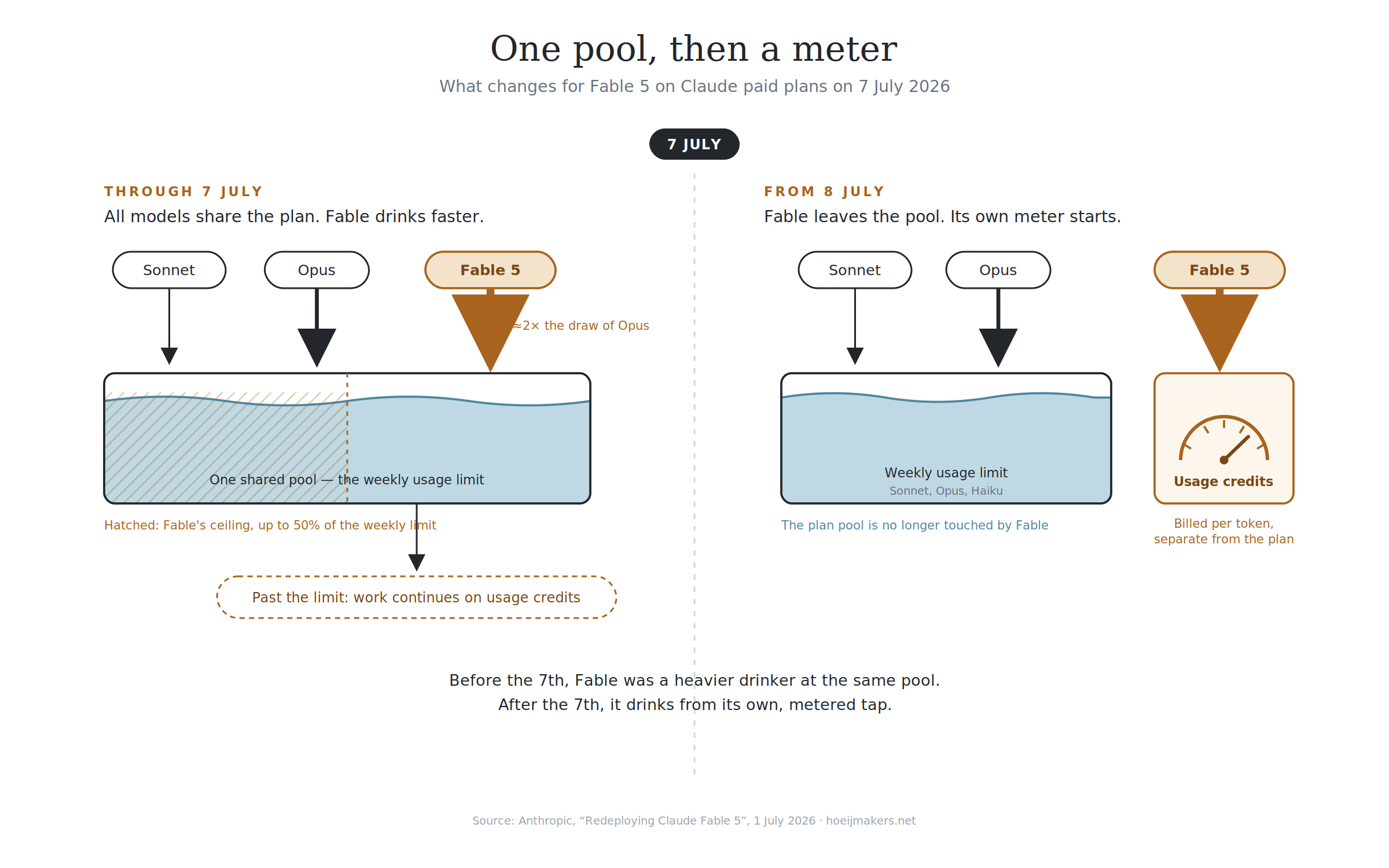
Fable draws from that pool faster than the others, roughly twice the rate of Opus for the same task. The diagram did not cost me an hour of Fable. It cost me an hour of Fable and a chunk of everything else I might have done in that stretch. Still, it was the same pool. Same subscription, same rules, just a thirstier model inside it.
The meter
That arrangement did not last. Fable has left the pool.
To use it now I switch on usage credits and pay per token, on top of the subscription I already pay every month: ten dollars a million tokens in, fifty a million out, the same overage rate that runs on every plan, except there is no pool underneath it anymore to draw from first. Every other model I use still works the way it always has: pay once, use what's included, wait for the reset if I run dry. Fable does not offer a reset. It costs, every time, stacked on top of what I already pay.
That is the actual change, not the price tag. A subscription is supposed to be the thing that makes you stop counting. Fable turns back into something I count, every time, on a plan that otherwise asks me not to.
The shape
I do not mind paying for the diagram. It was worth what it took. What I am still working out is the shift underneath the price: Fable is no longer a heavier draw on the thing I already pay for, it is a second thing I pay for, one model at a time, each time I reach for it.
That changes how I reach for it. Not out of habit, the way I reach for Opus, but deliberately, the way you reach for something you know has its own bill attached. The strongest tool on the shelf is also the one I now think twice about before picking up.